Environment Context Ce
A scene-level context that describes the spatial prior of the video, including the place, daytime, environment type, and typical situation expected from the visible scene.
Training video anomaly detectors is challenging due to the difficulty and cost of annotating diverse and rare abnormal events. Although recent large vision-language models enable training-free inference, existing approaches mostly rely on holistic inference over sampled video and may miss context specific anomaly cues. In this paper, we present CSI-VAD, a training-free video anomaly detector that identifies abnormal events across diverse contexts. The key idea is to decompose each video into three distinct contexts (environment, objects, time) and perform context-specific inference in separate branches. Because we ground anomaly judgments solely in context-specific visual cues, we do not require predefined text prompts describing abnormal events or dataset-specific tuning. Experiments on UCF-Crime and UBnormal show that CSI-VAD consistently improves over the direct holistic baseline and achieves competitive performance against existing methods, showing the advantage of structured context decomposition for training-free video anomaly detection.
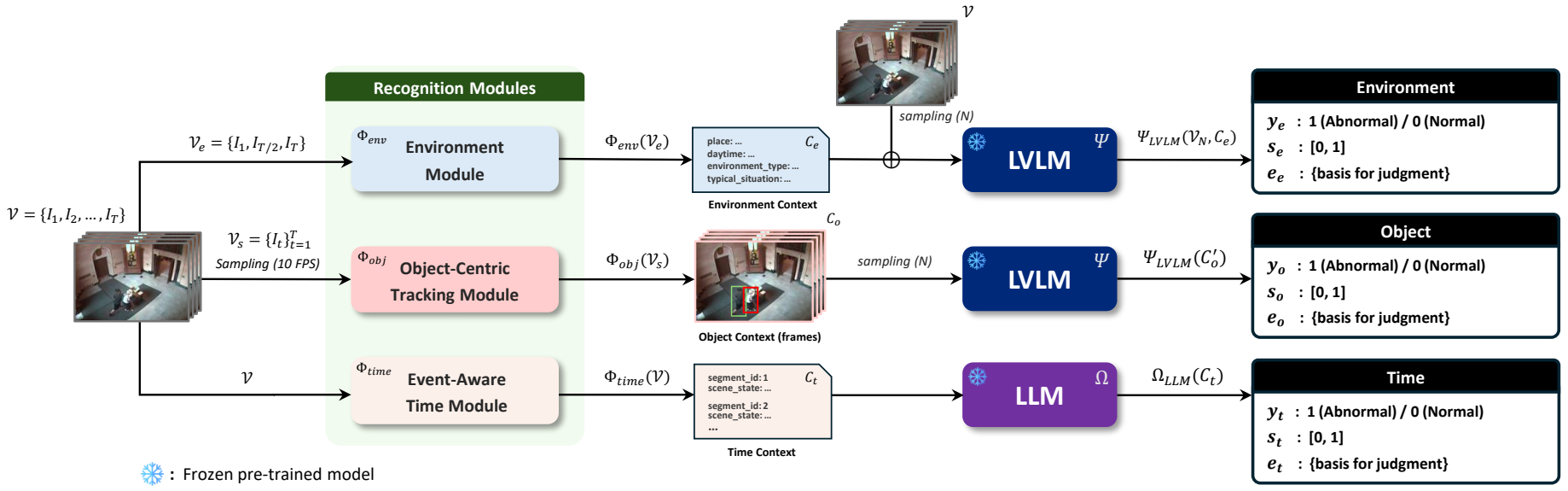
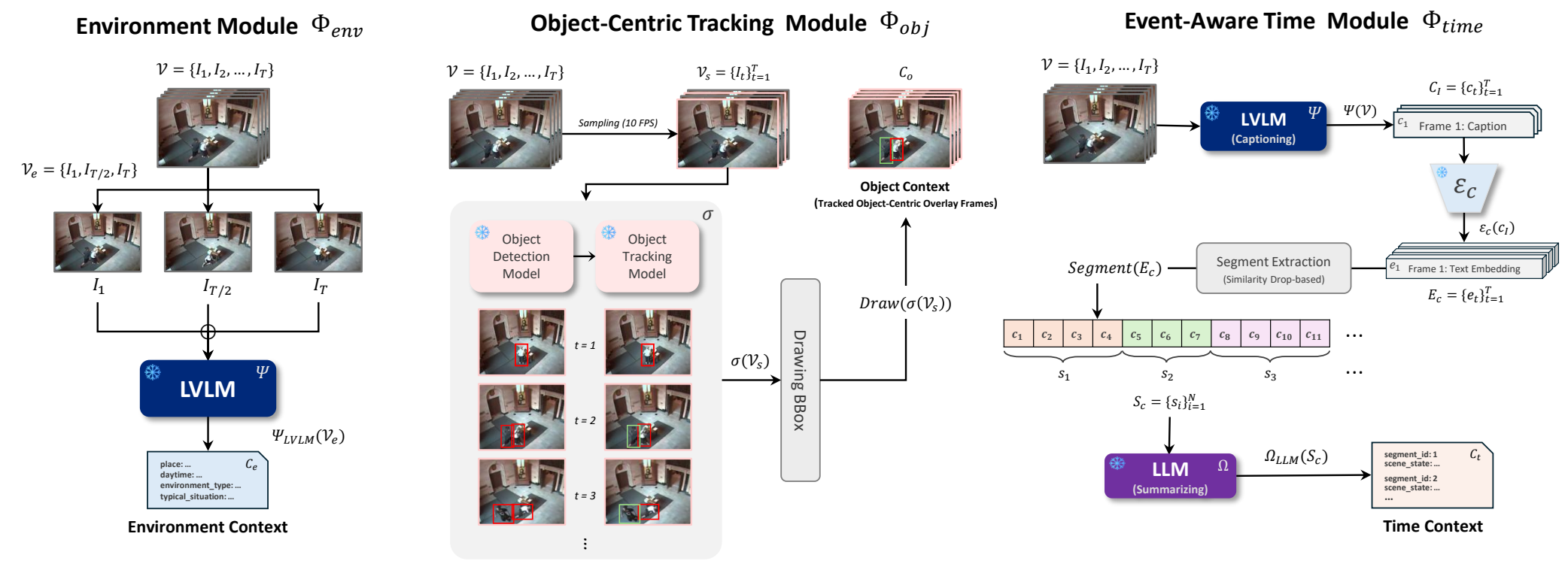
A scene-level context that describes the spatial prior of the video, including the place, daytime, environment type, and typical situation expected from the visible scene.
An object-emphasized visual sequence composed of original frames with tracking overlays, making object identity, location, motion, and interactions explicit.
An ordered textual summary of semantically coherent event segments, where each segment is represented by a concise scene state for temporal anomaly reasoning.
Performance comparison with representative existing video-level anomaly detection methods on UCF-Crime. Results for prior methods are taken from their original publications and follow their respective evaluation protocols.
| Method | Training-Free | AUC-ROC (%) |
|---|---|---|
| Sultani et al. (I3D) | × | 77.92 |
| RTFM (I3D) | × | 84.03 |
| S3R (I3D) | × | 85.99 |
| MGFN (I3D) | × | 86.98 |
| PEL (I3D) | × | 86.76 |
| BN-WVAD (I3D) | × | 87.24 |
| Anomaly Scorer (Base, X3D) | × | 91.34 |
| DUAL VAD | × | 92.33 |
| Ours256 (Max Ensemble) | ✓ | 89.33 |
| Ours256 (Mean Ensemble) | ✓ | 92.90 |
| Ours256 (Noisy-OR) | ✓ | 92.88 |
The context branches address different holistic inference failures.
The video depicts a typical scene in a subway station with people walking and using the turnstiles. There is no indication of abnormal, criminal, or deviant behavior.
The presence of a physical altercation, a person being forcibly removed by security, and a person running through the station while others assist a fallen individual suggest abnormal and potentially criminal behavior.
For the fighting anomaly video, the baseline fails by describing the scene as an ordinary subway situation. In contrast, the Time context branch captures the sustained physical conflict between people and correctly identifies the fighting event as anomalous.
The video shows a typical retail environment with customers browsing and interacting with store staff. There is no indication of abnormal, criminal, or deviant behavior.
The video captures a theft scenario where an individual in an orange shirt is seen taking items from a store shelf without paying, which is considered criminal behavior.
The baseline does not focus on the person's actions and fails by interpreting the video as a normal store scene. The Object context branch instead recognizes that the person in the orange shirt is stealing items, correctly detecting the shoplifting event.
The video shows a sudden and dramatic increase in brightness, likely indicating an explosion or fire, which is an abnormal event.
The video shows a typical scene of a parking lot at night with cars parked and moving in and out. There is no indication of abnormal, criminal, or deviant behavior.
The baseline ignores the parking lot at night context and falsely treats a sudden light change as an explosion or fire. The Environment context branch accounts for the night-time parking-lot setting and correctly decides that the video is normal.
The video shows multiple instances of chaotic events, restraints, altercations, and individuals being forcibly removed, which indicate abnormal/criminal/deviant behavior.
The presence of a person pointing a firearm in the waiting area is a clear indication of abnormal/criminal behavior.
The video initially shows a normal traffic scene with vehicles moving along a road. However, it abruptly transitions to an explosion with thick smoke, indicating a sudden and severe event.
The video captures a car crash involving multiple vehicles, which is an unusual and potentially dangerous event that deviates from typical traffic behavior.
The video depicts a robbery in progress where an individual wearing a mask and carrying a bag enters the store, approaches the cashier, and appears to be robbing the establishment by taking money from the cash register. This is an unusual and criminal activity that deviates significantly from the typical expected activities in a retail store.
The video shows a group of people engaging in what appears to be a physical altercation involving a stick. This is not a typical activity expected in a busy street market during daytime.